
Culture Shock has wrapped principal photography...and boy was it a whirlwind!


It’s official! After a little over one year of development a rigerous few months of crowdfunding, and 7 shoot days total, Culture Shock has wrapped principal photography on its pilot episode.
I had the privilege of serving as the crowdfunding lead, executive producer, and senior production designer on this pilot — and today, I wanted to share some updates, reflections, and shared sentiments from my fellow crew members about what we learned and what it really took to pull this thing off.
When we first started Culture Shock, the concept felt almost perfectly on the nose: a mockumentary comedy about acting students trying to survive the ebs and flows of drama school, their relationships with each other, and their relationships with themselves.
We thought the chaos would stay on the page (It didn’t).
What began as a satire about performance art and culture quickly became a crash course in endurance, creativity ingenuity, and caffeine management.

The Culture Shock pilot cost roughly $8,000 to produce (with $5,000 coming from our successful crowdfunding campaign!) We didn’t have the biggest budget or the most time (in fact, some days, it felt like we had neither) but what we did have was a team full of folks who refused to quit in the face of adversity. Producer Myles Haywood captured it best:
“As with any big production, you're going to have ups and downs. We were never going to have enough time, money, or planning. But one thing this cast and crew did have was resilience. When we took hits, we bounced back up and kept rolling. Regardless of what was happening, we had to get the shot... and we managed to do just that.” — Myles Haywood, Producer
Mind you, “getting the shot” often meant defying logic and throwing caution (and occasionally the shot list) to the wind. Our director, Khalil Louigene, recalls that the real drama often unfolded behind the camera rather than in front of it.

“The craziest parts of shooting this whole thing were rolling with the punches on things that didn’t go to plan. Pivoting, and pivoting well, allowed us to still get the amazing shots we needed.” — Khalil Louigene, Director
Khalil described the project as a "dream come true" — one that united his worlds, from the actors and crew he’d met through his alma mater, Montclair State University, to a production team full of emerging professionals making their mark on the industry. Lead actor Alex Fontes, who plays 'Steven' has had a longstanding relationship with Khalil as a result of their acting program at Montclair State, regarding him as a mentor and 'big brother' of sorts.
“I remember being invited to an early table read...I was introduced to Steven, and something about him just clicked with me. He’s this out-of-place white guy in a diverse acting program, and that fish-out-of-water feeling felt really familiar to me.” — Alex Fontes, Steven (Lead)

Alex reflected on how his own upbringing — in what he jokingly called “a very white, very small-town space” — shaped his understanding of belonging.
“It was crazy to come to Montclair and be exposed to actual culture and diversity face-to-face. Playing Steven kind of mirrored that journey...the act of trying to find your place, wanting to be part of something bigger, something that opens your mind.”
Speaking of 'bigger,' there were over 40 people working on the Culture Shock pilot across our cast and crew. Everyone came ready to give their all and deliver on Khalil’s vision. But no one knew what “delivering” would really mean until the cameras started rolling. Our Director of Photography, Juan Ospina, called it “a bumpy road.” Thirty pages, a limited crew, and the kind of resourcefulness that turns a classroom into a soundstage and a hallway into a miracle.
“We knew what we were up against. It was challenging for sure, but I relied on my team. They’re the reason the project ended up being what it is — an amazing experience.” — Juan Ospina, D.O.P.
Juan worked closely alongside Khalil for months to ensure that his vision for the first episode of Culture Shock would be brought to life. Their respect and admiration for each other is unparalleled.
“Khalil knew what he wanted. He knew the vision. He’s an actor, so watching him direct talent was incredible and on top of that, he gave me absolute trust with the camera — full creative freedom," Juan said. “It felt liberating."

We were true explorers on set. Trying new things became more of a norm than following the book. Miraculously, even when we had no idea what the result would be, the experimentations ended up better than we imagined. That became the through line of Culture Shock: improvise, adapt, execute — even when all seems lost.
Case in point: due to a double-sided communication error, on day one of shooting, we lost access to our main location. (Yes, day one.) But instead of crumbling and 86-ing the entire weekend, the team pulled together and rerouted the shoot on the fly.

By the second weekend, the chaos had evolved into rhythm. The cast and crew found a flow — riffing, improvising, and leaning into the unpredictable.
“Even when things got hectic, it always came back to that spirit of collaboration. Everyone just got what the story was trying to say — we were all figuring it out together. There’s something special about that: figuring things out with an open mind instead of a closed one.” — Alex Fontes, Steven (Lead)

It was as if spontaneity, open-mindedness, and sheer creative talent all collided on the set of Culture Shock to make this pilot what it was, and we could not have asked for a more incredible crew.
From second D.O.P. Khushi Patel, whose input set the tone for our two-camera compositions, assistant production designer Zitlali Marcial, and Frank Cettina — affectionately dubbed ‘Bob the Builder’' for somehow being a grip, gaffer, and audio mixer all in the same shoot, without missing a beat — to our incredible actors, production assistants, stills photographers, transport assistants... this pilot would not be possible without you. For their time, for their talent, and for their trust we are eternally grateful.
I walked away from set feeling as though I’d been immersed in another world. I learned so much and found community among young artists eager to build, stretch, and break the limits of what’s possible. And maybe that’s the real essence of Culture Shock: not the perfect takes, but the imperfect ones that brought us closer together... the late-night laughs, the spontaneous rewrites, the moments where everything seemed to fall apart and somehow came back together again.
Now that the cameras have stopped rolling, I feel a quiet satisfaction (the kind that comes from knowing you made something bigger than yourself. Something messy, human, and honest. Something that genuinely reflects the very world it satirizes).
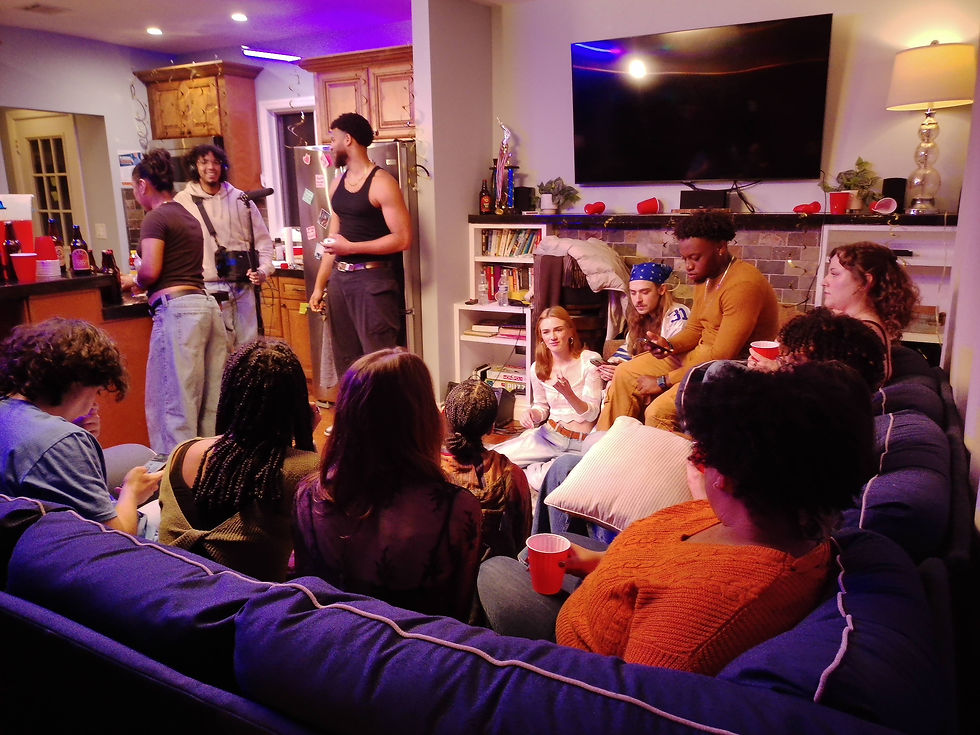
As we begin post-production and planning for Culture Shock's next chapter, I'll leave you with this.
To all our future audiences: yes, Culture Shock is a comedy. But behind every awkward punchline was a team willing to learn that that sometimes, the best art happens when nothing goes according to plan.
We look forward to show the world what we've been cooking up here. It was quite the roller coaster but if there’s one thing we learned for sure , it’s that real culture shock was realizing how much we'd love every chaotic second of it.


Comments